
Xavier University Athletics
Xavier Nation Magazine Feature: X Factor?
12.29.16 | Men's Basketball, Athletic Department
Each season, it seems one player surprises and delights both coaches and fans. Is Sean O’Mara next?
Summer for college kids conjures thoughts of road trips, pizza boxes stacked floor-to-ceiling, sleeping till noon, and working out thumbs texting and tweeting.
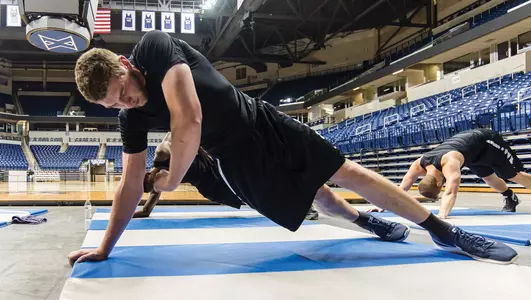
Then there's Sean O'Mara, who spent the summer between his sophomore and junior years at Xavier working out everything but his thumbs.
Pizza was off the table, replaced by chicken, fish, and steamed vegetables. Late wakeups? Early workouts. O'Mara's roadie of note took him to a sweltering gym in Houston, battling bigger men inside and working to developing the face-up game increasingly essential these days for players standing 6-foot-10 on a basketball court, as O'Mara does.
At his family's expense—about $2,000, O'Mara figures—he attended the player development camp run by former NBA player and coach turned development guru John Lucas. "It was a lot of hard work," O'Mara says. "But it was really cool."
From Xavier's perspective, the coolest part was O'Mara investing so much in himself, and not from his bank account. O'Mara's commitment to improvement was evident throughout the spring and summer, from how much time he spent in the gym to how he worked out to what he ate, coach Chris Mack says.
"His approach to the offseason has been very workmanlike," Mack says. "It's not just the John Lucas camp. He's lifting, he's in the gym more than I've ever seen. And not only has he put in the work, he's eating right, watching his calories. He is as focused as any player I've seen over an offseason."
O'Mara, who averaged 3.2 points and 1.9 rebounds in 7 minutes a game as a sophomore, knows the opportunity is out there this season. Xavier says goodbye to James Farr and Jalen Reynolds in the frontcourt, players who combined to average better than 20 points and 14 rebounds in 2015–2016. Each played about 20 minutes a game.
"He was behind a couple of guys who were as good as anybody in the BIG EAST," Mack says.
"He knows he has a huge opportunity. But he didn't just wait his turn. He put in the time."
O'Mara huddled with Matt Jennings, Xavier's head strength and conditioning coach, right after the season to get a plan to improve O'Mara's fitness level. "He gave me a bunch of stuff: treadmill, the skier, the rower," O'Mara says. O'Mara was a faithful pupil, on cardio equipment and in the weight room, and even adopted the Insanity 60-day workout for good measure, Mack says. But it was at the Lucas camp that O'Mara had his epiphany.
"As much as you might run or do other stuff, basketball is such a good workout in itself, as long as you work as hard as you can at it," he says. "It's not a bad thing at all to be working in the gym as much as you can. You can get so much more, skill-development-wise, out of a basketball workout, along with the stamina and the conditioning."
Lucas's summer sessions are renowned both for their tempo (fast) and their temperatures (hot). "In the summertime, he will put a lock on the thermostat," camp instructor Matt Howard told the Houston Press two years ago. Says O'Mara: "There's a nice gym and a bad gym, and you never know which one you're going to get."
While summering in Houston, O'Mara also got:
• Early wakeup calls: "For me, it was 6:45 every day. Your first workout starts at 8, but you leave the hotel at 7:30. When they say it starts at 8, it's just like we do here; you're full speed at 8. You've got to be ready. You get in, lace up, and you go."
• Nonstop action: "From there, it was 30 minutes of individual work, like post moves for a big guy like me," O'Mara says. "Guards would work on their own things. After that, you'd play for a half hour, 1-on-1 or 2-on-2 with just your position group. After that it's guards and bigs [together], whether you play full court or a drill. Then we'd go 3-on-3 or 4-on-4 or maybe just a little bit of 5-on-5, nonstop, for an hour. Combined with the heat, it was a really good way to stay in shape, or get in shape if that's what you were trying to do."
• Individual attention: "The coaches are always right next to you. I was surprised. For a camp that has as much notoriety as that one…you really get a lot of individual coaching. In a matter of two weeks, I had become a lot closer with coaches to the point that if I asked them to get up extra shots, they'd work with me. In the morning, there were more guys, but honestly the groups never got bigger than 20 people. In the afternoon they'd break it down by age group and skill level. There were kids all the way down to [middle] school level. And Lucas didn't treat them any differently than he treated any of us. You could see that some of these kids were pretty good, too. He'd throw an eighth-grader in with college guys every once in a while to see how he did."
Lucas, who has since joined the Houston Rockets staff as an assistant coach in charge of player development, counts among his player-development alumni such talents as LeBron James, Kobe Bryant, Andre Iguodala, DeAndre Jordan, Patrick Beverly, Tristan Thompson, and former Xavier standout James Posey, among many others. "The competition speaks for itself," O'Mara says.
"It's a great idea, but it's not cheap," Mack says. "You're going to go down there and get to play with talented players and great instructors, and you're going to come out of it in great shape. Sean really took advantage of his time there."
O'Mara, listed at 247 pounds last season, says he was around 10 percent body fat by the time it ended in March. By mid-summer, he was down to 8½ percent body fat, with a goal of 6 percent, and had shed 15 pounds. He overhauled his diet as well, drinking plain water and eating plenty of chicken and fish, even turkey burgers instead of beef.
"That part has definitely been difficult, but the more you do it the easier it becomes," O'Mara says. "Your body gets used to certain foods. I went on a family trip between summer sessions, and everybody was getting these big, fried meals; I look at a menu now and find I only want certain things anyway. Good things, based on how you've been treating your body."
For O'Mara, it's all part of the same plan: Turning all the offseason time he's invested into more time on the court.
"I don't want my physical conditioning to be any reason for me not to be on the floor this year," O'Mara says. "Whether it's 30 minutes a game, 20 minutes a game, whatever, I don't want to come out because I'm tired."
O'Mara took two courses in American Sign Language to be able to better communicate with two cousins who are hearing-impaired, he says.
"They're not deaf, but their hearing is pretty bad," O'Mara says. "They know [ASL] and my mom does, too. I'd like to be able to talk to them more."
O'Mara says students mostly worked with partners, practicing signs back and forth and shooting video of it. He said he was a little lost at first, but gradually grew more comfortable.
"When we started, I think I knew [the sign for] 'more'; my mom taught that to me," he says.
"The first week I was watching vocabulary videos, and I remember thinking, 'I think I may have gotten myself in over my head.' Visual learning is probably easier for most people. You see people do it and it clicks immediately. It's really not as difficult as it looks."
Then there's Sean O'Mara, who spent the summer between his sophomore and junior years at Xavier working out everything but his thumbs.
Pizza was off the table, replaced by chicken, fish, and steamed vegetables. Late wakeups? Early workouts. O'Mara's roadie of note took him to a sweltering gym in Houston, battling bigger men inside and working to developing the face-up game increasingly essential these days for players standing 6-foot-10 on a basketball court, as O'Mara does.
At his family's expense—about $2,000, O'Mara figures—he attended the player development camp run by former NBA player and coach turned development guru John Lucas. "It was a lot of hard work," O'Mara says. "But it was really cool."
From Xavier's perspective, the coolest part was O'Mara investing so much in himself, and not from his bank account. O'Mara's commitment to improvement was evident throughout the spring and summer, from how much time he spent in the gym to how he worked out to what he ate, coach Chris Mack says.
"His approach to the offseason has been very workmanlike," Mack says. "It's not just the John Lucas camp. He's lifting, he's in the gym more than I've ever seen. And not only has he put in the work, he's eating right, watching his calories. He is as focused as any player I've seen over an offseason."
O'Mara, who averaged 3.2 points and 1.9 rebounds in 7 minutes a game as a sophomore, knows the opportunity is out there this season. Xavier says goodbye to James Farr and Jalen Reynolds in the frontcourt, players who combined to average better than 20 points and 14 rebounds in 2015–2016. Each played about 20 minutes a game.
"He was behind a couple of guys who were as good as anybody in the BIG EAST," Mack says.
"He knows he has a huge opportunity. But he didn't just wait his turn. He put in the time."
O'Mara huddled with Matt Jennings, Xavier's head strength and conditioning coach, right after the season to get a plan to improve O'Mara's fitness level. "He gave me a bunch of stuff: treadmill, the skier, the rower," O'Mara says. O'Mara was a faithful pupil, on cardio equipment and in the weight room, and even adopted the Insanity 60-day workout for good measure, Mack says. But it was at the Lucas camp that O'Mara had his epiphany.
"As much as you might run or do other stuff, basketball is such a good workout in itself, as long as you work as hard as you can at it," he says. "It's not a bad thing at all to be working in the gym as much as you can. You can get so much more, skill-development-wise, out of a basketball workout, along with the stamina and the conditioning."
Lucas's summer sessions are renowned both for their tempo (fast) and their temperatures (hot). "In the summertime, he will put a lock on the thermostat," camp instructor Matt Howard told the Houston Press two years ago. Says O'Mara: "There's a nice gym and a bad gym, and you never know which one you're going to get."
While summering in Houston, O'Mara also got:
• Early wakeup calls: "For me, it was 6:45 every day. Your first workout starts at 8, but you leave the hotel at 7:30. When they say it starts at 8, it's just like we do here; you're full speed at 8. You've got to be ready. You get in, lace up, and you go."
• Nonstop action: "From there, it was 30 minutes of individual work, like post moves for a big guy like me," O'Mara says. "Guards would work on their own things. After that, you'd play for a half hour, 1-on-1 or 2-on-2 with just your position group. After that it's guards and bigs [together], whether you play full court or a drill. Then we'd go 3-on-3 or 4-on-4 or maybe just a little bit of 5-on-5, nonstop, for an hour. Combined with the heat, it was a really good way to stay in shape, or get in shape if that's what you were trying to do."
• Individual attention: "The coaches are always right next to you. I was surprised. For a camp that has as much notoriety as that one…you really get a lot of individual coaching. In a matter of two weeks, I had become a lot closer with coaches to the point that if I asked them to get up extra shots, they'd work with me. In the morning, there were more guys, but honestly the groups never got bigger than 20 people. In the afternoon they'd break it down by age group and skill level. There were kids all the way down to [middle] school level. And Lucas didn't treat them any differently than he treated any of us. You could see that some of these kids were pretty good, too. He'd throw an eighth-grader in with college guys every once in a while to see how he did."
Lucas, who has since joined the Houston Rockets staff as an assistant coach in charge of player development, counts among his player-development alumni such talents as LeBron James, Kobe Bryant, Andre Iguodala, DeAndre Jordan, Patrick Beverly, Tristan Thompson, and former Xavier standout James Posey, among many others. "The competition speaks for itself," O'Mara says.
"It's a great idea, but it's not cheap," Mack says. "You're going to go down there and get to play with talented players and great instructors, and you're going to come out of it in great shape. Sean really took advantage of his time there."
O'Mara, listed at 247 pounds last season, says he was around 10 percent body fat by the time it ended in March. By mid-summer, he was down to 8½ percent body fat, with a goal of 6 percent, and had shed 15 pounds. He overhauled his diet as well, drinking plain water and eating plenty of chicken and fish, even turkey burgers instead of beef.
"That part has definitely been difficult, but the more you do it the easier it becomes," O'Mara says. "Your body gets used to certain foods. I went on a family trip between summer sessions, and everybody was getting these big, fried meals; I look at a menu now and find I only want certain things anyway. Good things, based on how you've been treating your body."
For O'Mara, it's all part of the same plan: Turning all the offseason time he's invested into more time on the court.
"I don't want my physical conditioning to be any reason for me not to be on the floor this year," O'Mara says. "Whether it's 30 minutes a game, 20 minutes a game, whatever, I don't want to come out because I'm tired."
SIGNS OF LOVE
When it came time for Sean O'Mara to fulfill his language requirement at Xavier, he didn't opt for a rehash of a foreign language he'd taken in high school. The junior from Glen Ellyn, Illinois, had something different—and for his family, more meaningful—in mind.O'Mara took two courses in American Sign Language to be able to better communicate with two cousins who are hearing-impaired, he says.
"They're not deaf, but their hearing is pretty bad," O'Mara says. "They know [ASL] and my mom does, too. I'd like to be able to talk to them more."
O'Mara says students mostly worked with partners, practicing signs back and forth and shooting video of it. He said he was a little lost at first, but gradually grew more comfortable.
"When we started, I think I knew [the sign for] 'more'; my mom taught that to me," he says.
"The first week I was watching vocabulary videos, and I remember thinking, 'I think I may have gotten myself in over my head.' Visual learning is probably easier for most people. You see people do it and it clicks immediately. It's really not as difficult as it looks."


Players Mentioned

Forward
/ Men's Basketball
Forward/Center
/ Men's Basketball
Forward
/ Men's BasketballHIGHLIGHTS | Baseball at ECU (Game 1)
Saturday, February 14
HIGHLIGHTS | Women's Basketball vs. Villanova
Thursday, February 12
HIGHLIGHTS | Men's Basketball at No. 17 St. John's
Tuesday, February 10
HIGHLIGHTS | Women's Basketball at Providence
Sunday, February 08