
Xavier University Athletics
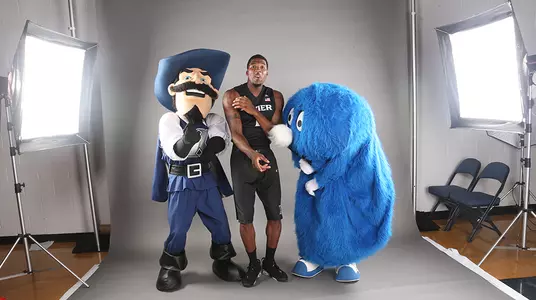
Xavier Nation Magazine Feature: A Gentle Giant
12.23.15 | Men's Basketball, Athletic Department, Featured
Jalen Reynolds provides Xavier toughness on the court, but reveals a softer side in everyday life.
Xavier Nation Magazine debuted in November 2014 as a publication produced by Xavier Athletics, designed specifically for its passionate and supportive fans. Xavier Nation aims to bring the alumni, fans and friends of Xavier content that can't be found anywhere else. The magazine goes beyond the statistics and history of a traditional media guide with stories that bring to life the coaches and athletes who represent Xavier.
Read one of the features from the magazine about who forward Jalen Reynolds really is off the court.
It's the first question. He answers without hesitation.
Who are you?
"I'm Jalen Reynolds. Born and raised in Detroit, Michigan. I've been playing basketball all my life. I'm a caring person. I hate to see people struggling. I'm a good guy. Very chivalrous. I'm fun to be around."
Next question.
Who do you think people think you are?
"People who don't know me probably think I'm angry because they watch me play basketball and think that I'm a guy who doesn't like the world. That's not true at all."
And finally…
Who do you want people to think you are?
"A person who's respectful to others. A total beast on the court. I want to be that person kids look up to and say, 'I want to be like him.'"
There is a lot at stake for Jalen Reynolds. The Xavier basketball player is on track to earn a bachelor's degree in social work in May. He will have one year of basketball eligibility remaining, but it is likely he will be playing professionally somewhere a year from now. He wants to take care of his family. He wants to do good in the community. He wants the big payday. He wants to play in the National Basketball Association.
He's got the body for it. Reynolds is a physical specimen—a chiseled 6-foot-10, 232-pound athletic, long-armed, intense competitor who can dunk with the best of 'em. When he talks about NBA models, he mentions Oklahoma City Thunder star Russell Westbrook and Houston Rockets star Dwight Howard, in part because of how they carry themselves.
On the court, he has shown flashes of greatness—and a temper. He's developed a bit of a reputation with officials. He finished last season with nine technical fouls—the most anyone at Xavier can remember in one season—and has 12 in his career. He is physical with opponents. He plays with great passion, intensity, and emotion. He gets too many silly frustration/retaliation fouls. He also dunks—hard. He scowls. He pounds his chest. He yells. He inspires the crowd and teammates.
Off the court, he has a huge smile, loves interacting with children, visits homeless shelters, and gives food to people on the streets of New York City. He'll talk to anyone, shake their hand, sign an autograph, converse. Especially kids; he adores kids. He has an engaging personality, a likability that makes family, friends, and Xavier officials want so badly for Reynolds to succeed. He can be charming. And he makes mistakes. He is 22 years old and still growing up.
Who are you?
Indeed.
"What people get to see is about five percent of Jalen, not necessarily the whole package," says Jeremy Growe, Xavier director of basketball operations.
"It's a complex story," says Chris Barbour, assistant director of student-athlete academic support services. "He's viewed as somewhat of an enigma with a world of talent—talent that has to be roped in at times."
Who Are You?
When Xavier plays in the BIG EAST Conference tournament in New York City, the team often goes out for a nice meal. It's common for players to request takeout boxes so they can bring food back to their rooms for a snack later.
After a dinner in 2014, Reynolds started collecting leftovers and walked out with shopping bags full of takeout boxes. Not just his, but from teammates and others in the Xavier party. He strayed from the group walking back to the Westin Hotel on Times Square and sought out homeless men and women so he could give them food from the restaurant. He did it again in 2015.
"That," Xavier head coach Chris Mack says, "was quintessential Jalen. He has a huge heart."
"I get a rush," Reynolds says. "I'm doing something good, giving back. I want to keep helping others."
Reynolds was taking a sociology course—Survey of Society in Social Work—last fall and went to a homeless shelter in Cincinnati's Over-the-Rhine neighborhood in order to write a paper.
There, Reynolds talked to homeless men and women about how they eat, sleep, live; how they ended up homeless. One man was clearly irritated and shouting about food. "Why are you angry?" Reynolds asked. "I don't know," the man responded. "I'm just angry all the time."
Reynolds learned that the man's parents died when he was younger. He didn't have family for support and he turned to drugs. He became broke and homeless.
"I came back to school and wanted to take all my clothes and just give them away," Reynolds says. "It makes you realize you have it pretty good."
"He came here with the intent of bringing Xavier a national championship and making a lot of money," Barbour says. "Now he's got people on his mind. He wants to help."
When Xavier traveled to Brazil in August 2014 for a series of exhibition games, the team conducted a basketball clinic for 60 to 70 children in a favela—the term used for slums. Reynolds thrived. He has a natural ability to connect with kids.
"That's him at his best," Growe says. "These are kids [in Brazil] who literally have nothing. And he's just as good with kids at Xavier camps."
"He probably sees himself in some of the kids he spends time with—kids who have dreams," Mack says.
"I just love kids," Reynolds says. "I love seeing kids smile. I love making them laugh. I'm just a goofy guy myself."
Reynolds was in the campus cafeteria this past spring when he saw Kimberly Dulin, an assistant director in Xavier's Admission Office, who was with a group of high school students interested in attending Xavier. Reynolds struck up a conversation and asked Dulin what she did at Xavier. When she told him, he said, "If you ever need me to talk to students, let me know."
"I thought, wow, I might need you this afternoon," Dulin says. "I thought it would be awesome for high school students to hear from him. I checked with my colleagues, and I got permission. Everyone in my office was thrilled that he would do that. I told him, 'I'll text you if there is an opportunity, but it might be in the next couple hours.' He said he didn't mind at all."
She invited him to speak that very day to students. Reynolds went back to his apartment, changed into a nice shirt and his best pair of pants, and hurried over to Cintas Center, where 60 to 70 students were listening to different speakers. He ended up giving an impromptu talk for close to 10 minutes.
"He took the microphone, stood up, and did a fabulous job," Dulin says.
Reynolds talked about why he chose Xavier, his academic experience, the support and personalized attention he receives, and more. Afterward, he took pictures with students and their family members.
"I was nervous," Reynolds says. "I didn't have anything prepared. I just started talking about myself and why I came to Xavier. I probably stuttered twice, but I picked it up. The kids asked a lot of questions. It was a good experience."
"He was open and honest and relaxed," Dulin says. "After he finished, I told him he did such a great job. I was very proud of him."
Who Are You?
Last March, during the NCAA Tournament, it was reported that a Xavier student filed a complaint about Reynolds with the university. Reynolds was allowed to play in the Musketeers' Sweet 16 game against Arizona because the incident was still being investigated.
Two months later, Xavier athletic director Greg Christopher told The Cincinnati Enquirer the matter was resolved through the student conduct process. Xavier cannot discuss the incident because of privacy laws. Reynolds does not care to get into any specifics.
"People say that you come to college to learn and grow as a person," Reynolds says. "That's what I am doing. I am no different from most college students. I am trying to develop myself so that when I leave Xavier I am prepared to be out in the real world. It's not always easy. But I am trying, and I have great support here from a lot of people."
Coaches and school officials understand that when they recruit student-athletes and bring them to Xavier, they then have to provide whatever support is necessary to help those players be successful in and out of the classroom.
Reynolds has been loyal to Xavier, coming to the school despite twice being academically ineligible (more on that later); and Xavier has been loyal to Reynolds, creatively providing support at every turn.
In May, Mack called Reynolds into his office and made a strong recommendation. He proposed that Reynolds go to Houston, Texas, and spend some time with John Lucas Basketball Resources. According to
johnlucasenterprises.com, Lucas "has created an extensive program that supports and helps athletes, at-risk or not, to progress in their athletic potential, achieve sobriety, and remain drug-free." Mack had already spoken to Jalen's mother, Rachel Thomas, about it and had her support. "Anything that's to help Jalen, I am all for it," Thomas says. "I'm glad the opportunity was offered to him."
Lucas is a former longtime NBA player and coach who works with athletes and coaches from all levels and all sports. His program works on the mental and physical. There are alcohol and drug prevention sessions, individual counseling and mentoring, and lots of basketball and working out. Lucas himself is a recovered alcoholic and drug user.
Mack thought Reynolds had made some poor decisions in the previous six months or so. He thought Reynolds had heard the same messages from Xavier coaches for three years and maybe it was time for some new voices. Lucas, Mack thought, could offer great perspective.
Reynolds's immediate reaction was, "No way. Why would I need to go there?" He was apprehensive. He had no idea what to expect.
He thought it through. He thought hard. And he decided to go.
It was for seven weeks. Xavier's athletic department paid the way.
Like other hurdles in his past, Reynolds adjusted. There were players from all over the country there. He says he began to open up in daily meetings with "Greg," his assigned counselor. He easily embraced the competitive basketball and understood he was getting better. He says his eyes were opened by the alcohol and drug sessions.
Does he have an alcohol problem? "I was going out too much," he says. "Like a lot of college students." Drug problem? "No," he says.
The theme in Houston was similar to what he hears from his coaches, counselors, and family: Make good choices.
Of the whole experience, Reynolds says, "It was helpful. It was focusing on me not wasting my talent."
He came back to Cincinnati in early July. Coaches believe they saw a difference but everyone was reserving judgment until the school year and basketball started.
"He's taken a big jump every year [in basketball and maturity]," Mack says. "People expect so much because he is so talented. The consistency factor with him is what we really need—getting the same attitude every day."
"I don't think we'll see the difference until we're in the thick of school and games and practices, having to go to study hall and make great choices off the floor," Growe says.
"The whole coaching staff would say that he's still a developing person. At his core he's a really great person. That's what makes the ups and downs easier. You know you're dealing with someone whose heart's in the right place."
Who Are You?
Reynolds's path to Xavier was anything but smooth.
His father left when he was young and was never an influence in his life growing up. His mother, Rachel Thomas, remarried but largely raised three boys on her own, often working as many as 14 to 16 hours a day. "It wasn't easy," she says. "I did what needed to be done." She had multiple jobs, including as a reservation manager at Embassy Suites Hotel, a career adviser at Michigan Works, and a travel agent for Discount Global. At times, Thomas felt guilty because she worked so much and left her children in the hands of daycare and babysitters.
Jalen has two older brothers—Deon, 27, and Corey, 24. The boys never wanted for anything. They had plenty of food, clothes, whatever they needed. Thomas made sure of it. "We weren't poor," she says. She made the tough decision to move the family from Ferndale, a more industrial community in southeast Detroit, to Farmington Hills, one of the safest cities in the country.
"She got them away from an environment that could've destroyed them," her brother Terry says. "My sister is tough, no-nonsense, protective."
Terry and Troy Thomas are Jalen's uncles. Jalen says they served as father figures.
"As a family we have tried to instill good values in Jalen," Terry Thomas says. "Our prayer and our hope is that Jalen makes the right decisions all the time. So when he makes a wrong decision, I'm in his ear. I'm like a broken record. I say things so much I get tired of hearing them."
Be humble. Be respectful. Be unselfish. Be a good citizen of the world. Keep it clean. Watch your temper. People are watching everything that you do. Those are some of Uncle Terry's constant messages.
"Being from Detroit, I think he thinks he has to portray this tough-guy image," Terry says. "I tell him: 'You don't have to impress anyone. Just play the best basketball you can on the court and be the best man you can be off the court.'"
Rachel describes her son as sensitive, strong-minded, funny, charismatic, and cocky.
"He's just very passionate," she says. "He's a gentle giant."
Reynolds attended multiple high schools, had to sit out his junior season because of Michigan's transfer rules, did not have the academic requirements to enroll at Xavier in 2011, and attended Brewster Academy in New Hampshire, where he played with former Musketeer Semaj Christon and won a prep school national championship. Reynolds then came to XU in 2012, only to learn he was academically ineligible to compete as a freshman.
"Jalen has gone through a lot to get to where he is," Terry says. "I'm proud of him."
Rather than go to a junior college where he could play right away, Reynolds opted to get student loans and pay his own way to Xavier as a freshman. He could not be an official part of the basketball team. No practices. No travel. No games. He and teammate Myles Davis, who was in the same situation, sat out together.
"It took a toll on us," Davis says. "We tried to help each other stay as focused as possible. It wasn't easy at all. It helped Jalen grow up. It helped him realize basketball can be taken away from you quickly—just like that! I think it was a blessing and a curse. It drove us more to want to get back."
"I think it humbled me a lot from an academic standpoint," Reynolds says. "I really focused on my grades and on trying to build relationships with professors. That whole year was tough, man. I had to get through it. It was a blessing from God."
He learned about time management, being on time, getting work done on time, discipline.
The second semester of his freshman year, Xavier enlisted the help of learning specialist Betsy Zimmerman, a friend of Sister Rose Ann Fleming's. A paid tutor, her challenge was (and is) to teach Reynolds study skills, how to dissect information, how to stay focused and organized and prioritize work.
Reynolds admits he wasn't keen on the idea at first. His attitude changed quickly. He soon began to trust "Miss Betsy" and understand that she could help him. He started getting better grades.
"I'm real," the 5-foot-4 Zimmerman says. "I'm honest. What you see is what you get. What you see is what you get with him, too. I don't know when trust developed. For me, he seems fairly open."
They typically meet two to three times a week, including some Sundays. This past summer, Reynolds proactively reached out to Zimmerman for help; that is progress.
"I think he understands the impact of a college degree," Zimmerman says. "I think he sees his skill as a basketball player is a blessing for him. I don't think he takes it for granted. He doesn't feel entitled; he's very appreciative of what he has."
Academics don't come easily. Chris Barbour also works with Reynolds and pushes him regularly.
"There are days that it's challenging," Barbour says. "There are days when we go toe to toe. But I'm not going to give up on him."
Who Are You?
Reynolds's consistency on the court might be the key to Xavier's 2015–2016 season. When he's in the game, the Musketeers are, well, much better. When he's in foul trouble, it's a problem for him and his team.
Consider Reynolds collecting four fouls in 10 minutes in Xavier's first meeting last season with Long Beach State, then 12 days later picking up four fouls in 13 minutes in the second meeting. He averaged six points and 5.5 rebounds in those games despite the limited playing time.
Last January, he had a double-double at Providence College with 14 points and 13 rebounds, then followed with two points and four rebounds in 10 minutes against DePaul and two points and five rebounds in 14 minutes at Georgetown.
He ended up averaging 9.9 points and 6.1 rebounds with a team-high 36 blocked shots.
Everyone agrees: Reynolds has to avoid foul trouble this season. He has to better learn how to deal with officials missing a push by an opponent only to see Reynolds's retaliation. He has to better learn to let it go when an opponent gets away with an elbow or shove.
"I would say I've got a short temper sometimes," Reynolds admits. "My main focus for this year is just to calm down a little bit and let everything come to me. I'm still learning."
"His will to compete and to be the best is so high it clouds his judgement at times," Xavier assistant coach Mike Pegues says. "What's missing is being more cerebral in the midst of being a physical warrior out there. The best warriors had it upstairs. They take the time to win the mental battle."
Rachel Thomas finds herself yelling at the TV when she is watching Xavier games if her son gets overly physical. She makes sure she talks to him soon afterward. "You have to show you're in control at all times," she
tells him.
"We get on him," she says. "I don't let him get away with anything. If I have to stand on a chair, I'll get in his face."
Who Are You?
Jalen Reynolds will spend this season trying to strike a balance, trying to be the toughest guy on the court while also being likeable.
Patient and poised. Competitive and aggressive. How does he make them work together?
"The better players always have an edge," Pegues says. "It's OK to have an edge, but you also have to have some parameters. There are lines you just don't cross." It's a fine line, of course.
Every team benefits from having a player who exemplifies toughness.
In last year's Sweet 16 NCAA Tournament game, the Musketeers faced Arizona and its highly touted frontline. Reynolds came off the bench for 12 points on 5-of-9 shooting. He and Matt Stainbrook (17 points, 10 rebounds) outplayed Arizona inside. Reynolds got everyone's attention on a spin-and-dunk over Arizona's 7-foot Kaleb Tarczewski in the second half.
"You always need that guy who isn't scared of one person," Davis says. "Jalen would make it evident to you that he's not scared of you and he will play with anybody. You have to love that as a teammate. We get our toughness from Jalen, and everybody follows."
Davis praises the progress Reynolds has made in controlling his emotions and smiles as he talks about Reynolds's first season on the team when he was known for his outbursts, kicking or throwing the ball, yelling, and storming off the court in practices.
"He wore his emotions on his sleeve all the time," Davis says. "He means well, but he might go about it the wrong way. He still gets mad, but he's more controlled."
Reynolds wants to be a leader and a good teammate. He wants to set an example for the younger players.
Reynolds knows he is moody. He admits that some days, he lets school, family issues, and girl trouble affect his demeanor. "We all have our days," he says. "Sometimes it's hard to switch to happy mode."
The coaching staff cannot be around him 24/7. His family is more than 250 miles away. This is the year Jalen Dior Reynolds has to make great decisions on his own. All the time.
"We always talk to Jalen about what's out there for him if he does the right things and what's out there if he doesn't make the right choices," Pegues says. "I think we have his attention. But it's a process."
Read one of the features from the magazine about who forward Jalen Reynolds really is off the court.
It's the first question. He answers without hesitation.
Who are you?
"I'm Jalen Reynolds. Born and raised in Detroit, Michigan. I've been playing basketball all my life. I'm a caring person. I hate to see people struggling. I'm a good guy. Very chivalrous. I'm fun to be around."
Next question.
Who do you think people think you are?
"People who don't know me probably think I'm angry because they watch me play basketball and think that I'm a guy who doesn't like the world. That's not true at all."
And finally…
Who do you want people to think you are?
"A person who's respectful to others. A total beast on the court. I want to be that person kids look up to and say, 'I want to be like him.'"
There is a lot at stake for Jalen Reynolds. The Xavier basketball player is on track to earn a bachelor's degree in social work in May. He will have one year of basketball eligibility remaining, but it is likely he will be playing professionally somewhere a year from now. He wants to take care of his family. He wants to do good in the community. He wants the big payday. He wants to play in the National Basketball Association.
He's got the body for it. Reynolds is a physical specimen—a chiseled 6-foot-10, 232-pound athletic, long-armed, intense competitor who can dunk with the best of 'em. When he talks about NBA models, he mentions Oklahoma City Thunder star Russell Westbrook and Houston Rockets star Dwight Howard, in part because of how they carry themselves.
On the court, he has shown flashes of greatness—and a temper. He's developed a bit of a reputation with officials. He finished last season with nine technical fouls—the most anyone at Xavier can remember in one season—and has 12 in his career. He is physical with opponents. He plays with great passion, intensity, and emotion. He gets too many silly frustration/retaliation fouls. He also dunks—hard. He scowls. He pounds his chest. He yells. He inspires the crowd and teammates.
Off the court, he has a huge smile, loves interacting with children, visits homeless shelters, and gives food to people on the streets of New York City. He'll talk to anyone, shake their hand, sign an autograph, converse. Especially kids; he adores kids. He has an engaging personality, a likability that makes family, friends, and Xavier officials want so badly for Reynolds to succeed. He can be charming. And he makes mistakes. He is 22 years old and still growing up.
Who are you?
Indeed.
"What people get to see is about five percent of Jalen, not necessarily the whole package," says Jeremy Growe, Xavier director of basketball operations.
"It's a complex story," says Chris Barbour, assistant director of student-athlete academic support services. "He's viewed as somewhat of an enigma with a world of talent—talent that has to be roped in at times."
Who Are You?
When Xavier plays in the BIG EAST Conference tournament in New York City, the team often goes out for a nice meal. It's common for players to request takeout boxes so they can bring food back to their rooms for a snack later.
After a dinner in 2014, Reynolds started collecting leftovers and walked out with shopping bags full of takeout boxes. Not just his, but from teammates and others in the Xavier party. He strayed from the group walking back to the Westin Hotel on Times Square and sought out homeless men and women so he could give them food from the restaurant. He did it again in 2015.
"That," Xavier head coach Chris Mack says, "was quintessential Jalen. He has a huge heart."
"I get a rush," Reynolds says. "I'm doing something good, giving back. I want to keep helping others."
Reynolds was taking a sociology course—Survey of Society in Social Work—last fall and went to a homeless shelter in Cincinnati's Over-the-Rhine neighborhood in order to write a paper.
There, Reynolds talked to homeless men and women about how they eat, sleep, live; how they ended up homeless. One man was clearly irritated and shouting about food. "Why are you angry?" Reynolds asked. "I don't know," the man responded. "I'm just angry all the time."
Reynolds learned that the man's parents died when he was younger. He didn't have family for support and he turned to drugs. He became broke and homeless.
"I came back to school and wanted to take all my clothes and just give them away," Reynolds says. "It makes you realize you have it pretty good."
"He came here with the intent of bringing Xavier a national championship and making a lot of money," Barbour says. "Now he's got people on his mind. He wants to help."
When Xavier traveled to Brazil in August 2014 for a series of exhibition games, the team conducted a basketball clinic for 60 to 70 children in a favela—the term used for slums. Reynolds thrived. He has a natural ability to connect with kids.
"That's him at his best," Growe says. "These are kids [in Brazil] who literally have nothing. And he's just as good with kids at Xavier camps."
"He probably sees himself in some of the kids he spends time with—kids who have dreams," Mack says.
"I just love kids," Reynolds says. "I love seeing kids smile. I love making them laugh. I'm just a goofy guy myself."
Reynolds was in the campus cafeteria this past spring when he saw Kimberly Dulin, an assistant director in Xavier's Admission Office, who was with a group of high school students interested in attending Xavier. Reynolds struck up a conversation and asked Dulin what she did at Xavier. When she told him, he said, "If you ever need me to talk to students, let me know."
"I thought, wow, I might need you this afternoon," Dulin says. "I thought it would be awesome for high school students to hear from him. I checked with my colleagues, and I got permission. Everyone in my office was thrilled that he would do that. I told him, 'I'll text you if there is an opportunity, but it might be in the next couple hours.' He said he didn't mind at all."
She invited him to speak that very day to students. Reynolds went back to his apartment, changed into a nice shirt and his best pair of pants, and hurried over to Cintas Center, where 60 to 70 students were listening to different speakers. He ended up giving an impromptu talk for close to 10 minutes.
"He took the microphone, stood up, and did a fabulous job," Dulin says.
Reynolds talked about why he chose Xavier, his academic experience, the support and personalized attention he receives, and more. Afterward, he took pictures with students and their family members.
"I was nervous," Reynolds says. "I didn't have anything prepared. I just started talking about myself and why I came to Xavier. I probably stuttered twice, but I picked it up. The kids asked a lot of questions. It was a good experience."
"He was open and honest and relaxed," Dulin says. "After he finished, I told him he did such a great job. I was very proud of him."
Who Are You?
Last March, during the NCAA Tournament, it was reported that a Xavier student filed a complaint about Reynolds with the university. Reynolds was allowed to play in the Musketeers' Sweet 16 game against Arizona because the incident was still being investigated.
Two months later, Xavier athletic director Greg Christopher told The Cincinnati Enquirer the matter was resolved through the student conduct process. Xavier cannot discuss the incident because of privacy laws. Reynolds does not care to get into any specifics.
"People say that you come to college to learn and grow as a person," Reynolds says. "That's what I am doing. I am no different from most college students. I am trying to develop myself so that when I leave Xavier I am prepared to be out in the real world. It's not always easy. But I am trying, and I have great support here from a lot of people."
Coaches and school officials understand that when they recruit student-athletes and bring them to Xavier, they then have to provide whatever support is necessary to help those players be successful in and out of the classroom.
Reynolds has been loyal to Xavier, coming to the school despite twice being academically ineligible (more on that later); and Xavier has been loyal to Reynolds, creatively providing support at every turn.
In May, Mack called Reynolds into his office and made a strong recommendation. He proposed that Reynolds go to Houston, Texas, and spend some time with John Lucas Basketball Resources. According to
johnlucasenterprises.com, Lucas "has created an extensive program that supports and helps athletes, at-risk or not, to progress in their athletic potential, achieve sobriety, and remain drug-free." Mack had already spoken to Jalen's mother, Rachel Thomas, about it and had her support. "Anything that's to help Jalen, I am all for it," Thomas says. "I'm glad the opportunity was offered to him."
Lucas is a former longtime NBA player and coach who works with athletes and coaches from all levels and all sports. His program works on the mental and physical. There are alcohol and drug prevention sessions, individual counseling and mentoring, and lots of basketball and working out. Lucas himself is a recovered alcoholic and drug user.
Mack thought Reynolds had made some poor decisions in the previous six months or so. He thought Reynolds had heard the same messages from Xavier coaches for three years and maybe it was time for some new voices. Lucas, Mack thought, could offer great perspective.
Reynolds's immediate reaction was, "No way. Why would I need to go there?" He was apprehensive. He had no idea what to expect.
He thought it through. He thought hard. And he decided to go.
It was for seven weeks. Xavier's athletic department paid the way.
Like other hurdles in his past, Reynolds adjusted. There were players from all over the country there. He says he began to open up in daily meetings with "Greg," his assigned counselor. He easily embraced the competitive basketball and understood he was getting better. He says his eyes were opened by the alcohol and drug sessions.
Does he have an alcohol problem? "I was going out too much," he says. "Like a lot of college students." Drug problem? "No," he says.
The theme in Houston was similar to what he hears from his coaches, counselors, and family: Make good choices.
Of the whole experience, Reynolds says, "It was helpful. It was focusing on me not wasting my talent."
He came back to Cincinnati in early July. Coaches believe they saw a difference but everyone was reserving judgment until the school year and basketball started.
"He's taken a big jump every year [in basketball and maturity]," Mack says. "People expect so much because he is so talented. The consistency factor with him is what we really need—getting the same attitude every day."
"I don't think we'll see the difference until we're in the thick of school and games and practices, having to go to study hall and make great choices off the floor," Growe says.
"The whole coaching staff would say that he's still a developing person. At his core he's a really great person. That's what makes the ups and downs easier. You know you're dealing with someone whose heart's in the right place."
Who Are You?
Reynolds's path to Xavier was anything but smooth.
His father left when he was young and was never an influence in his life growing up. His mother, Rachel Thomas, remarried but largely raised three boys on her own, often working as many as 14 to 16 hours a day. "It wasn't easy," she says. "I did what needed to be done." She had multiple jobs, including as a reservation manager at Embassy Suites Hotel, a career adviser at Michigan Works, and a travel agent for Discount Global. At times, Thomas felt guilty because she worked so much and left her children in the hands of daycare and babysitters.
Jalen has two older brothers—Deon, 27, and Corey, 24. The boys never wanted for anything. They had plenty of food, clothes, whatever they needed. Thomas made sure of it. "We weren't poor," she says. She made the tough decision to move the family from Ferndale, a more industrial community in southeast Detroit, to Farmington Hills, one of the safest cities in the country.
"She got them away from an environment that could've destroyed them," her brother Terry says. "My sister is tough, no-nonsense, protective."
Terry and Troy Thomas are Jalen's uncles. Jalen says they served as father figures.
"As a family we have tried to instill good values in Jalen," Terry Thomas says. "Our prayer and our hope is that Jalen makes the right decisions all the time. So when he makes a wrong decision, I'm in his ear. I'm like a broken record. I say things so much I get tired of hearing them."
Be humble. Be respectful. Be unselfish. Be a good citizen of the world. Keep it clean. Watch your temper. People are watching everything that you do. Those are some of Uncle Terry's constant messages.
"Being from Detroit, I think he thinks he has to portray this tough-guy image," Terry says. "I tell him: 'You don't have to impress anyone. Just play the best basketball you can on the court and be the best man you can be off the court.'"
Rachel describes her son as sensitive, strong-minded, funny, charismatic, and cocky.
"He's just very passionate," she says. "He's a gentle giant."
Reynolds attended multiple high schools, had to sit out his junior season because of Michigan's transfer rules, did not have the academic requirements to enroll at Xavier in 2011, and attended Brewster Academy in New Hampshire, where he played with former Musketeer Semaj Christon and won a prep school national championship. Reynolds then came to XU in 2012, only to learn he was academically ineligible to compete as a freshman.
"Jalen has gone through a lot to get to where he is," Terry says. "I'm proud of him."
Rather than go to a junior college where he could play right away, Reynolds opted to get student loans and pay his own way to Xavier as a freshman. He could not be an official part of the basketball team. No practices. No travel. No games. He and teammate Myles Davis, who was in the same situation, sat out together.
"It took a toll on us," Davis says. "We tried to help each other stay as focused as possible. It wasn't easy at all. It helped Jalen grow up. It helped him realize basketball can be taken away from you quickly—just like that! I think it was a blessing and a curse. It drove us more to want to get back."
"I think it humbled me a lot from an academic standpoint," Reynolds says. "I really focused on my grades and on trying to build relationships with professors. That whole year was tough, man. I had to get through it. It was a blessing from God."
He learned about time management, being on time, getting work done on time, discipline.
The second semester of his freshman year, Xavier enlisted the help of learning specialist Betsy Zimmerman, a friend of Sister Rose Ann Fleming's. A paid tutor, her challenge was (and is) to teach Reynolds study skills, how to dissect information, how to stay focused and organized and prioritize work.
Reynolds admits he wasn't keen on the idea at first. His attitude changed quickly. He soon began to trust "Miss Betsy" and understand that she could help him. He started getting better grades.
"I'm real," the 5-foot-4 Zimmerman says. "I'm honest. What you see is what you get. What you see is what you get with him, too. I don't know when trust developed. For me, he seems fairly open."
They typically meet two to three times a week, including some Sundays. This past summer, Reynolds proactively reached out to Zimmerman for help; that is progress.
"I think he understands the impact of a college degree," Zimmerman says. "I think he sees his skill as a basketball player is a blessing for him. I don't think he takes it for granted. He doesn't feel entitled; he's very appreciative of what he has."
Academics don't come easily. Chris Barbour also works with Reynolds and pushes him regularly.
"There are days that it's challenging," Barbour says. "There are days when we go toe to toe. But I'm not going to give up on him."
Who Are You?
Reynolds's consistency on the court might be the key to Xavier's 2015–2016 season. When he's in the game, the Musketeers are, well, much better. When he's in foul trouble, it's a problem for him and his team.
Consider Reynolds collecting four fouls in 10 minutes in Xavier's first meeting last season with Long Beach State, then 12 days later picking up four fouls in 13 minutes in the second meeting. He averaged six points and 5.5 rebounds in those games despite the limited playing time.
Last January, he had a double-double at Providence College with 14 points and 13 rebounds, then followed with two points and four rebounds in 10 minutes against DePaul and two points and five rebounds in 14 minutes at Georgetown.
He ended up averaging 9.9 points and 6.1 rebounds with a team-high 36 blocked shots.
Everyone agrees: Reynolds has to avoid foul trouble this season. He has to better learn how to deal with officials missing a push by an opponent only to see Reynolds's retaliation. He has to better learn to let it go when an opponent gets away with an elbow or shove.
"I would say I've got a short temper sometimes," Reynolds admits. "My main focus for this year is just to calm down a little bit and let everything come to me. I'm still learning."
"His will to compete and to be the best is so high it clouds his judgement at times," Xavier assistant coach Mike Pegues says. "What's missing is being more cerebral in the midst of being a physical warrior out there. The best warriors had it upstairs. They take the time to win the mental battle."
Rachel Thomas finds herself yelling at the TV when she is watching Xavier games if her son gets overly physical. She makes sure she talks to him soon afterward. "You have to show you're in control at all times," she
tells him.
"We get on him," she says. "I don't let him get away with anything. If I have to stand on a chair, I'll get in his face."
Who Are You?
Jalen Reynolds will spend this season trying to strike a balance, trying to be the toughest guy on the court while also being likeable.
Patient and poised. Competitive and aggressive. How does he make them work together?
"The better players always have an edge," Pegues says. "It's OK to have an edge, but you also have to have some parameters. There are lines you just don't cross." It's a fine line, of course.
Every team benefits from having a player who exemplifies toughness.
In last year's Sweet 16 NCAA Tournament game, the Musketeers faced Arizona and its highly touted frontline. Reynolds came off the bench for 12 points on 5-of-9 shooting. He and Matt Stainbrook (17 points, 10 rebounds) outplayed Arizona inside. Reynolds got everyone's attention on a spin-and-dunk over Arizona's 7-foot Kaleb Tarczewski in the second half.
"You always need that guy who isn't scared of one person," Davis says. "Jalen would make it evident to you that he's not scared of you and he will play with anybody. You have to love that as a teammate. We get our toughness from Jalen, and everybody follows."
Davis praises the progress Reynolds has made in controlling his emotions and smiles as he talks about Reynolds's first season on the team when he was known for his outbursts, kicking or throwing the ball, yelling, and storming off the court in practices.
"He wore his emotions on his sleeve all the time," Davis says. "He means well, but he might go about it the wrong way. He still gets mad, but he's more controlled."
Reynolds wants to be a leader and a good teammate. He wants to set an example for the younger players.
Reynolds knows he is moody. He admits that some days, he lets school, family issues, and girl trouble affect his demeanor. "We all have our days," he says. "Sometimes it's hard to switch to happy mode."
The coaching staff cannot be around him 24/7. His family is more than 250 miles away. This is the year Jalen Dior Reynolds has to make great decisions on his own. All the time.
"We always talk to Jalen about what's out there for him if he does the right things and what's out there if he doesn't make the right choices," Pegues says. "I think we have his attention. But it's a process."


Players Mentioned

Guard
/ Men's Basketball
Forward
/ Men's Basketball
Center
/ Men's BasketballSunday, May 24
Saturday, May 23
Thursday, May 21
Saturday, May 16