
Xavier University Athletics
Xavier Nation Magazine Feature: In Good Hands
05.26.17 | Men's Basketball, Athletic Department, Featured
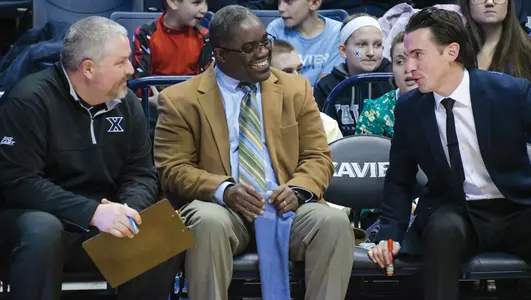
David Fluker is more than an athletic trainer. Players also see him as a mentor and friend.
Scan the bench at any Xavier men's basketball game and you'll sense the seamless teamwork among coaches, players, trainers, and support staff. Right in the middle of everything, unassuming and businesslike, you'll find head trainer David Fluker.
He might just be the most vital cog in the Xavier basketball machine, but you'd never hear that from him.
Fluker doesn't have to say anything. His actions as associate head athletic trainer, confidante to coaches, mentor and big brother to players, keeper of the XU basketball flame, father, and husband speak for themselves.
In a world where the word unique gets overused, Fluker holds a truly unique position on Xavier's athletic staff. He joined the training team in 1996 under Skip Prosser and treasures his connections to him and to the players who first pushed the program onto the national stage. He left for seven years to work on Bob Huggins's staff at the University of Cincinnati and (gasp!) was welcomed back to Xavier in 2010.
Fluker has led Xavier's embrace of the sports medicine, nutrition, and training advancements sweeping across intercollegiate athletics. His job and role—along with just about everything in college sports—have shifted dramatically in 20 years.
Yet Fluker says he still relies on two old-fashioned tools more than any others: his hands and his ears.
"I feel like the biggest healing tools I have are my hands," he says in his office at Cintas Center's training facilities. "There are athletes who never get a genuine healing touch in their lives. They're taught to act like tough guys and avoid interaction. Physical touch really breaks down a lot of barriers."
And that's when Fluker's ears take over. While massaging a player's sore shoulder or helping bend and stretch a surgically repaired knee, Fluker listens. He never knows what an athlete will want to talk about—often they just need to make a connection.
"When they see me for injury, they're vulnerable," he says. "But they can get things off their chest with me and know I'll keep it confidential. Sometimes there are things they don't even want their teammates to know."
Fluker relishes his opportunities to connect, mentor, and advise, especially as an African-American family man working with young African-American athletes who are often away from home for the first time. He was a "big brother" to players like Darnell Williams, Gary Lumpkin, and Lenny Brown because he wasn't much older than them back in the late 1990s; with graying hair now, Fluker laughs as he admits that maybe he's more of a "father figure" to the current team.
"Dave was a mentor to me," Williams says. "We could talk about anything. He's just a very genuine person, and everything he says and does is from the heart."
"I've been pretty close with Dave since my freshman year," says Dee Davis, whose final XU season was 2014–2015. "There weren't too many times we were in the same room when we weren't singing an old-school R&B song together, groups like the O'Jays, Earth Wind and Fire. I saw him as someone I could look to for wisdom or advice on life."
Fluker got his first taste of collegiate sports medicine when he hurt his knee playing football at Wilmington College. While his athletic career ended early, he was intrigued by the athletic training processes and pursued a bachelor's degree in sports medicine, graduating in 1986.
He later earned a master's degree in health education and human performance at Michigan State, where he worked as a graduate assistant athletic trainer with the football team under coach George Perles and interacted with standout players like Lorenzo White, Tony Mandarich, and Mark Ingram Sr.
A Cincinnati native and Sycamore High School graduate, Fluker returned to town to work in the sports medicine and rehabilitation field. His wife Crystal is also in the medical field, receiving a nursing degree from Xavier and currently working at Cincinnati Children's Hospital Medical Center.
They have six children, the youngest of whom is a high school senior. One daughter is a sophomore at Xavier.
Fluker's family was young, however, when Prosser hired him in 1996. Working in a small program on a tight budget, the assistant trainer position came with other duties—like arranging the basketball team's travel.
"The very first road trip under my direction was to Los Angeles to play Loyola Marymount," Fluker says. "We show up at the hotel, and there are tarps hanging all around the lobby because of construction. I had to explain it to Coach Prosser, who wasn't happy."
Williams remembers that, even then, Fluker was unflappable.
"Yes, that Loyola Marymount trip when the hotel was under construction," he says, laughing. "Dave had to figure out where we could stay so the noise wouldn't bother us, so we moved to the other side of the hotel. He handled everything for us back then."
Xavier beat LMU by 16.
The challenges of transforming XU's basketball program into a national power in the late '90s forged bonds that remain strong today.
"Dave had a chip on his shoulder at Xavier in those days, as we all did," Williams says. "He wanted us to stay healthy and win, and we all wanted to prove ourselves. We'd often practice late, and Dave would stay with us and provide treatment afterwards. We'd tell him to go home to his wife and kids, but he always stayed. We knew we were building something with the program, and none of us wanted to cut any corners."
Fluker calls his early Xavier teams "the group that built the Cintas Center."
"I am excited to welcome them whenever they come back to visit Xavier," Fluker says. "For many, I might really be the only familiar face here. The Cintas Center wasn't around when they played for Xavier, but I want them to feel like it's their home court, too. I always welcome them with open arms and help them if they ever need anything."
Fluker rattles off the names of former stars he's hosted in recent visits, including David West and James Posey. There are dozens of others he stays in touch with on a regular basis.
"My father had knee replacement surgery, and Dave would call and tell me how to take care of him afterwards," Williams says. "He always has checked up on me since our days at Xavier. He called me once at 3 a.m. when his son was born."
Fast-forwarding to today's Xavier athletes, Fluker says the technology of sports medicine has changed rapidly but relationships remain at the core of his role.
"I feel like a counselor to the players, especially the young men," he says. "The players like direction and encouragement. They want to be told the truth."
So do coaches, teammates, fans, and the media. The competing interests revolving around a star player's injury can—and often do—place Fluker in difficult situations, but he said he feels his experience has served him well in defining the difference between "hurt" and "injured."
"I've been around long enough to know when to keep something players tell me confidential and what needs to be shared with the coaching staff," he says. "I never hide injuries from the coaches, and the players know that. I'm interested in their long-term care and health, so I want them to be honest with me—but since injuries affect their playing time, sometimes they're hesitant to be honest."
A typical day during basketball season finds Fluker arriving at the Cintas Center at 9 a.m. for rehab work with XU athletes across all sports, followed by individual checkups with visiting team physicians. Then there's basketball practice, with pre- and post-practice treatment. Fluker usually heads home when the team study hall begins at 7 p.m.
For Xavier home games, Fluker's day might start a little later, but he won't leave the Cintas Center until 10 or 11 p.m.
He travels with the team to all away games, which he says he enjoys because he gets to spend more time with players without classes or the usual campus distractions. And probably talk about everything but basketball.
"I do feel that I'm a beacon of sorts for all student-athletes who come through Xavier," Fluker says. "I try to be a guide for them through my words and my life."
"Within the team and the coaching staff, Dave was an outlet for me to talk about whatever I wanted," Davis says. "I'll always be grateful to have had a chance to be around a trainer, mentor, and friend like him."
He might just be the most vital cog in the Xavier basketball machine, but you'd never hear that from him.
Fluker doesn't have to say anything. His actions as associate head athletic trainer, confidante to coaches, mentor and big brother to players, keeper of the XU basketball flame, father, and husband speak for themselves.
In a world where the word unique gets overused, Fluker holds a truly unique position on Xavier's athletic staff. He joined the training team in 1996 under Skip Prosser and treasures his connections to him and to the players who first pushed the program onto the national stage. He left for seven years to work on Bob Huggins's staff at the University of Cincinnati and (gasp!) was welcomed back to Xavier in 2010.
Fluker has led Xavier's embrace of the sports medicine, nutrition, and training advancements sweeping across intercollegiate athletics. His job and role—along with just about everything in college sports—have shifted dramatically in 20 years.
Yet Fluker says he still relies on two old-fashioned tools more than any others: his hands and his ears.
"I feel like the biggest healing tools I have are my hands," he says in his office at Cintas Center's training facilities. "There are athletes who never get a genuine healing touch in their lives. They're taught to act like tough guys and avoid interaction. Physical touch really breaks down a lot of barriers."
And that's when Fluker's ears take over. While massaging a player's sore shoulder or helping bend and stretch a surgically repaired knee, Fluker listens. He never knows what an athlete will want to talk about—often they just need to make a connection.
"When they see me for injury, they're vulnerable," he says. "But they can get things off their chest with me and know I'll keep it confidential. Sometimes there are things they don't even want their teammates to know."
Fluker relishes his opportunities to connect, mentor, and advise, especially as an African-American family man working with young African-American athletes who are often away from home for the first time. He was a "big brother" to players like Darnell Williams, Gary Lumpkin, and Lenny Brown because he wasn't much older than them back in the late 1990s; with graying hair now, Fluker laughs as he admits that maybe he's more of a "father figure" to the current team.
"Dave was a mentor to me," Williams says. "We could talk about anything. He's just a very genuine person, and everything he says and does is from the heart."
"I've been pretty close with Dave since my freshman year," says Dee Davis, whose final XU season was 2014–2015. "There weren't too many times we were in the same room when we weren't singing an old-school R&B song together, groups like the O'Jays, Earth Wind and Fire. I saw him as someone I could look to for wisdom or advice on life."
 |
BECOMING A PROSSER PROTEGE |
Fluker got his first taste of collegiate sports medicine when he hurt his knee playing football at Wilmington College. While his athletic career ended early, he was intrigued by the athletic training processes and pursued a bachelor's degree in sports medicine, graduating in 1986.
He later earned a master's degree in health education and human performance at Michigan State, where he worked as a graduate assistant athletic trainer with the football team under coach George Perles and interacted with standout players like Lorenzo White, Tony Mandarich, and Mark Ingram Sr.
A Cincinnati native and Sycamore High School graduate, Fluker returned to town to work in the sports medicine and rehabilitation field. His wife Crystal is also in the medical field, receiving a nursing degree from Xavier and currently working at Cincinnati Children's Hospital Medical Center.
They have six children, the youngest of whom is a high school senior. One daughter is a sophomore at Xavier.
Fluker's family was young, however, when Prosser hired him in 1996. Working in a small program on a tight budget, the assistant trainer position came with other duties—like arranging the basketball team's travel.
"The very first road trip under my direction was to Los Angeles to play Loyola Marymount," Fluker says. "We show up at the hotel, and there are tarps hanging all around the lobby because of construction. I had to explain it to Coach Prosser, who wasn't happy."
Williams remembers that, even then, Fluker was unflappable.
"Yes, that Loyola Marymount trip when the hotel was under construction," he says, laughing. "Dave had to figure out where we could stay so the noise wouldn't bother us, so we moved to the other side of the hotel. He handled everything for us back then."
Xavier beat LMU by 16.
The challenges of transforming XU's basketball program into a national power in the late '90s forged bonds that remain strong today.
"Dave had a chip on his shoulder at Xavier in those days, as we all did," Williams says. "He wanted us to stay healthy and win, and we all wanted to prove ourselves. We'd often practice late, and Dave would stay with us and provide treatment afterwards. We'd tell him to go home to his wife and kids, but he always stayed. We knew we were building something with the program, and none of us wanted to cut any corners."
Fluker calls his early Xavier teams "the group that built the Cintas Center."
"I am excited to welcome them whenever they come back to visit Xavier," Fluker says. "For many, I might really be the only familiar face here. The Cintas Center wasn't around when they played for Xavier, but I want them to feel like it's their home court, too. I always welcome them with open arms and help them if they ever need anything."
Fluker rattles off the names of former stars he's hosted in recent visits, including David West and James Posey. There are dozens of others he stays in touch with on a regular basis.
"My father had knee replacement surgery, and Dave would call and tell me how to take care of him afterwards," Williams says. "He always has checked up on me since our days at Xavier. He called me once at 3 a.m. when his son was born."
|
|
"I DO FEEL THAT I'M A BEACON" |
Fast-forwarding to today's Xavier athletes, Fluker says the technology of sports medicine has changed rapidly but relationships remain at the core of his role.
"I feel like a counselor to the players, especially the young men," he says. "The players like direction and encouragement. They want to be told the truth."
So do coaches, teammates, fans, and the media. The competing interests revolving around a star player's injury can—and often do—place Fluker in difficult situations, but he said he feels his experience has served him well in defining the difference between "hurt" and "injured."
"I've been around long enough to know when to keep something players tell me confidential and what needs to be shared with the coaching staff," he says. "I never hide injuries from the coaches, and the players know that. I'm interested in their long-term care and health, so I want them to be honest with me—but since injuries affect their playing time, sometimes they're hesitant to be honest."
A typical day during basketball season finds Fluker arriving at the Cintas Center at 9 a.m. for rehab work with XU athletes across all sports, followed by individual checkups with visiting team physicians. Then there's basketball practice, with pre- and post-practice treatment. Fluker usually heads home when the team study hall begins at 7 p.m.
For Xavier home games, Fluker's day might start a little later, but he won't leave the Cintas Center until 10 or 11 p.m.
He travels with the team to all away games, which he says he enjoys because he gets to spend more time with players without classes or the usual campus distractions. And probably talk about everything but basketball.
"I do feel that I'm a beacon of sorts for all student-athletes who come through Xavier," Fluker says. "I try to be a guide for them through my words and my life."
"Within the team and the coaching staff, Dave was an outlet for me to talk about whatever I wanted," Davis says. "I'll always be grateful to have had a chance to be around a trainer, mentor, and friend like him."

Sunday, May 24
Saturday, May 23
Thursday, May 21
Saturday, May 16